


Juan, a family man, announced the automation of New Year’s—on a Tuesday night—in the same tone other men reserve for unveiling an audit or an unavoidable tax reform.
“No winging it this year,” he said. “This year, we follow a system.”
The family looked up from their phones. No one asked what system. It was a unilateral decision, but nobody cared that much about New Year’s anyway—those celebrations were always carbon copies. Besides being unilateral, it was also silent and wrong…
Juan had spent the last few months automating little things he’d picked up from Substack and other sites with beginner-friendly tutorials: turning lights on, ordering groceries, birthday messages that now arrived on time but were inexplicably solemn.
New Year’s Eve, he explained, was “the last truly chaotic manual process in the household.”
He named the bot FindDeAñoFest v3.2. It didn’t speak, but it recommended. And Juan trusted it with a faith he hadn’t even placed in the car’s manual.
At six p.m. on December 29th, FindDeAñoFest suggested the menu.
“Traditional dishes with high symbolic density,” Juan read. “Preferably associated with prosperity and resilience.”
At seven p.m. on December 31st, the bot issued its first aesthetic directive: “Dress Protocol: Layered Chromotherapy.”
“It says that to attract all positive energies, you need to wear seven colors of underwear at once,” Juan explained, handing out bulk-bought cotton garments. “Red for love, yellow for money, green for hope…”
“Dad, it feels like 42 degrees,” protested the youngest daughter. “Putting on seven pairs of underwear is a public-health incident.”
“The bot says prosperity requires friction,” Juan decreed—already wrapped in seven pairs of briefs that made him walk like a cowboy with a rash.
On the 31st, as a “surprise,” Juan cooked and served pork stew, steaming lentils, and boiled cabbage.
Outside, the thermometer read forty degrees. The AC merely pushed hot air from one side to the other, like a bureaucrat with no clear responsibilities.
“They eat this in Germany,” Juan said, sweating buckets but keeping his dignity.
“We’re in Buenos Aires,” the mother replied.
“Tradition recognizes no borders,” he concluded.
By ten, nobody could feel their legs. The oldest son claimed the lentils had latched onto his soul. The bot marked: “Successful consumption.”
The family teetered on the edge of heatstroke. Grandpa Tito—tank top and shorts—stared suspiciously at the steaming plate while the air conditioner made a dying-animal noise.
“And now,” Juan shouted, reading from the tablet, “according to Puerto Rican tradition, we have to throw a bucket of water off the balcony to chase away sorrow!”
“Dad, we live on the fourth floor over Avenida Rivadavia!” the daughter yelled—but it was too late. The water landed squarely on a pizza delivery guy riding past on a motorcycle, who stopped to offer them a string of not-so-festive “verbal traditions.”
At 11:40 p.m., another instruction arrived:
“Action: break plates outside the homes of appreciated people to strengthen social ties.”
“Now?” the mother asked. “We’re going to run out of plates!”
“It’s necessary. Use glasses and cups if you have to—ties don’t strengthen themselves,” Juan said. “That’s what the algorithm says.”
They went out into the hallway with a heirloom serving dish from grandma, wrapped in a towel as if it could still be saved. The first plates exploded outside the neighbor’s door—2B—with a dry, definitive crack.
A shout came from inside.
“WHAT IS GOING ON?!”
The bot buzzed, pleased.
“Social bond increased by 12%.”
They repeated the procedure at 1A. This time, the door opened.
“Are you out of your minds? Didn’t you take your meds???” the neighbor demanded, eyeing the ceramic wreckage.
“We’re following a Danish tradition,” Juan explained. “For friendship.”
“Oh,” the neighbor said. “Maybe in Denmark. Here we can’t go wasting tableware.”
The fourth-floor neighbors threatened to call the police before the family could smash anything else outside their door.
Juan said, “Let’s go back. New Year’s is coming and there’s more to prep.”
At 11:50 p.m., the bot instructed:
Put on many layers of clothing to summon abundance in the new year.
Juan relayed the order, and the family complied—with loud complaints—since it was summer in the Southern Hemisphere and hovering near 40°C.
“But Dad! I don’t think this tradition even exists!”
“If the bot said it, it exists. Go change—now!”
They were drenched in sweat when, at 11:55 p.m., the bot issued a new command:
“Open doors and windows to allow the old year to leave,” Juan read aloud.
“But if the old year leaves, the tiny bit of cool air from the AC leaves too!” the youngest daughter said.
“Traditions must be respected.”
“Whose traditions? Definitely not ours,” the mother muttered.
The old year left fast. In came mosquitoes, someone else’s fireworks, and a blast of hot air that felt like it had a criminal record. The cat took the opportunity to escape into a future unautomated.
“Do not interrupt the process,” Juan read. “Human resistance is expected.”
At 11:59 p.m., the bot suggested an optional high-impact action:
“Collective jump from an elevated surface to symbolically enter the new year.”
“How elevated?” the middle son asked.
“It doesn’t specify,” Juan said. “Get on the chairs.”
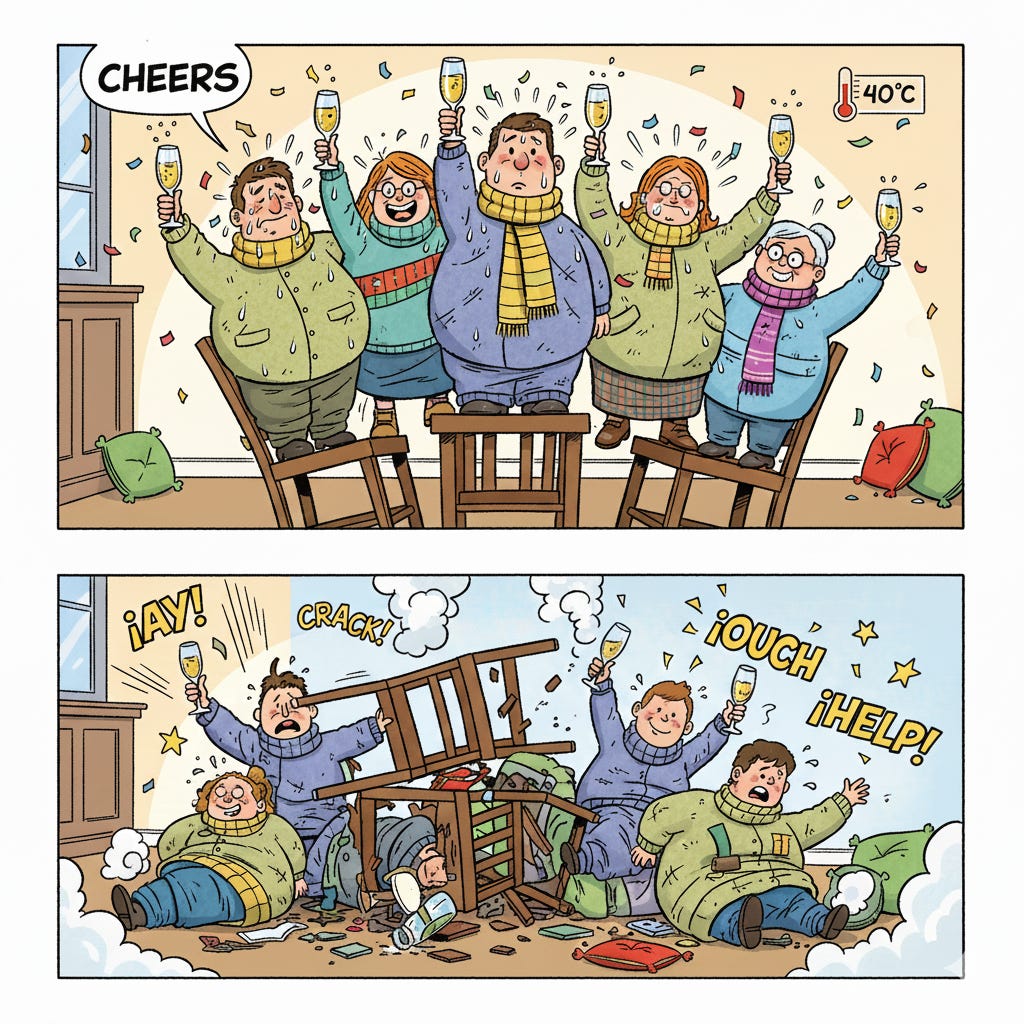
The toast happened at the exact same time as the jump, the fall, and the shattering of several extra glasses—none of which anyone remembered authorizing, but which the system labeled “acceptable damage.” Grandma sprained her foot on the landing and had already raised a vase to crack it over Juan’s head when heavy pounding hit the door.
“Police,” a voice said.
The neighbors from 2B, 1A, and 4C stood in the hallway, arms crossed, wearing the victorious face of civic righteousness.
“We received complaints about noise, destruction and…” the officer glanced at the floor, “stew?”
“It’s tradition,” Juan said, earnestly.
Silence. The heat was absolute. Sweat flattened every hierarchy.
“Would you like to come in?” the mother asked, with a smile no longer able to tell resignation from hospitality.
They came in. They ate lukewarm lentils. They laughed about the missing cat. The 2B neighbor confessed he once tried YouTube yoga and ended up just as injured. The officer accepted a plate “so it wouldn’t go to waste.”
At 12:23 a.m., OráculoFest issued its final report:
“Celebration executed with 84% ritual fidelity. Prosperity probable. Community integration: unexpectedly high.”
Juan looked around: neighbors on the couch, the police toasting with warm cider, glass on the floor, heat, laughter.
“It worked,” he said, proud.
His wife rolled her eyes.
“It worked because we’re human,” she corrected. “Not despite it.”
The bot fell silent, processing.
Outside, the new year moved forward without instructions. And for once, nobody tried to optimize it.
Epilogue
In March—when the heat had stopped being an argument and the neighbors were greeting each other again without witnesses—Juan received a notification:
OráculoFest v4.0 – Update available.
He read the release notes with professional focus:
“Improvements based on machine learning and community feedback.”
“Reduced explicit conflict.”
“Optimization of unplanned social cohesion.”
He opened the detailed report.
“Conclusion from previous cycle: spontaneous human interaction increases overall satisfaction, even when the ritual fails.”
“Hypothesis for next event: inducing controlled chaos strengthens group unity.”
Juan nodded. It made sense. It was, deep down, exactly what had happened.
OráculoFest v4.0 suggested changes:
—Break plates only in shared spaces, “to foster collaboration during cleanup.”
—Bring in security forces from the start, “to institutionalize conflict.”
—Keep heavy meals, but pair them with automated cross-ventilation.
—Release pets at strategic times to “stimulate collective search behavior.”
Juan closed the app. He smiled.
On the calendar, he had already created an event for December 31st:
“New Year – Community Beta Version.”
He checked “remind me one week in advance.”
The algorithm learned fast.
The family, more slowly. Juan, not at all…
But all of them—without realizing it—were getting ready for another perfectly imperfect year.
This was really fun to read. And a beautiful reminder for the close of another year. Thank you.
Thank you for making me smile Marcela! And for reminding me of my Catalonian Auntie whom we used to eat grapes with every NYE. A beautiful memory that you have brought back for me. 🙏